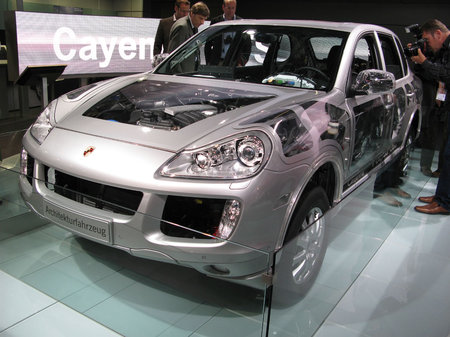
Clearly, the name “Cayenne“ also stands for “clarity“. And precisely that is the purpose of a “laboratory on wheels” quite unique the world over and used by Porsche’s engineers for the ongoing development of safe and reliable electronic systems: The “transparent” Sports Utility enables the Company’s engineers to test future electronic systems on the road under genuine driving conditions at an earlier point in time than any of the Company’s competitors. The leadership ensured in this way will enable Porsche even more than before to develop the most sophisticated electronic systems with absolute reliability and outstanding performance.
Large cut-outs in the doors, lids and wheel arches of the Cayenne protected by clear plastic covers for driving tests enable the development engineers to observe, check out and, where necessary, exchange virtually all electrical and electronic power-consuming items, cables and connections. With the exception of the driver’s seat, the this very special model intentionally lacks its complete interior, the other seats and the dashboard, thus providing direct and free access to all electronic components fitted within the vehicle itself.
More important is the fact that the pictures are of the Hybrid version which Porsche is planning for a 2009 launch. Not much information is available but expect PDK or Porsche double clutch gearbox along with a hybrid-gasoline, hybrid-diesel to provide propulsion.
The “transparent“ Cayenne, benefiting from this open design, offers two significant advantages in one: First, the development engineers are able to emulate and configure old and new functions including sensors and actuators, as well as the infrastructure of every Porsche vehicle without a major effort, even if the function involved is actually not even included in the Cayenne. One example is the process of testing a rear spoiler moving up automatically at speed, the complete component including its control system being fitted in the interior of Porsche’s Sports Utility Vehicle. The second point is that this unique laboratory on wheels serves to verify not only the reliability of new components, but also their interaction within the overall system under real-life driving conditions.
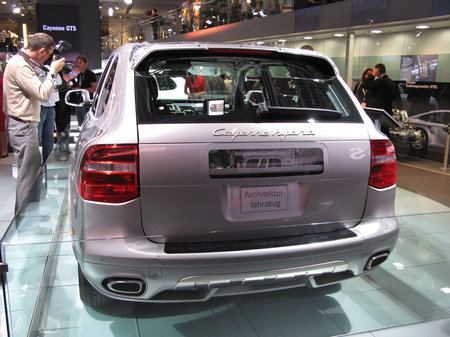
Using their “laboratory on wheels“, Porsche’s engineers are able to start testing the complete on-board electronics of new model generations about a year earlier than before. And this is a significant time-saving, considering that the overall period for developing a new vehicle is only a few years.
So far engineers were not able to test new systems under realistic conditions until the first prototypes were available, at the very earliest. Now, using the “transparent” Porsche, they are in a position to check and verify environmental conditions such as heat, cold or air humidity as well as vibrations under practical driving conditions at a much earlier point in time. Starting the test phase so much earlier, the engineers are thus in a position to enhance quality to an even higher level and have more time for the set-up process so important for and typical of Porsche.
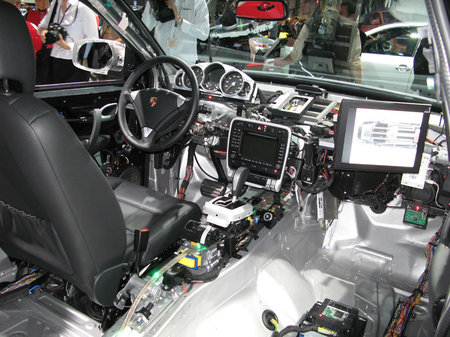
The “laboratory on wheels” adds a further level to Porsche’s pyramid-shaped test philosophy in the development of electronic components. This pyramid starts with the assurance of quality by suppliers and is followed by elaborate tests conducted by Porsche’s own engineers – including virtual simulation or tests on dynamometers and test rigs. Actual verification of the overall system, however, cannot start until real-time signals are generated and reliably processed in a rolling vehicle. Now the new “laboratory on wheels” also supports Porsche’s proven principle of making fewer and fewer changes the closer a vehicle comes to the start of series production.
With Porsche being a premium manufacturer strictly oriented to the customer, safety and reliability receive top priority in the process of digitalisation. Following the Cayenne, the current 911 Carrera was the second Porsche to enter the market with a comprehensive electronic on-board network. Indeed, without this electronic network a lot of the progress featured in the new 911 and based on the ongoing development of mechanical systems would simply not have been possible. The best example is the Sports Chrono Package which, incorporating no less than 16 control units, allows the driver of the 911 Carrera, Boxster and Cayman S to choose an even more sporting and dynamic style of motoring.

Porsche’s engineers responsible for electronic development are already working on a second generation of networks. Using a new architecture, they are systematically determining which functions are to be allocated to which control units, how many computers are in use and how the various units and systems communicate with one another. The core of this architecture is a standard platform later to be featured in all new Porsche cars. And it is precisely for this reason that the “electronic laboratory on wheels” is the ideal tool for an even more sophisticated development process.
Source : Techfresh